he corner of 14th Street and Avenue A was never meant to hold a crowd. Yet by 7 p.m. on a humid Thursday。several hundred people had wedged themselves between the bodega awning and the community garden fence, drawn by a sound that cut through traffic like a blade: the deep, resonant thud of a barrel drum and the sharp clang of a metal gong. This was how Aguero was celebrated with drums and gongs—not in a concert hall, but on the pavement he walked every day for thirty years.
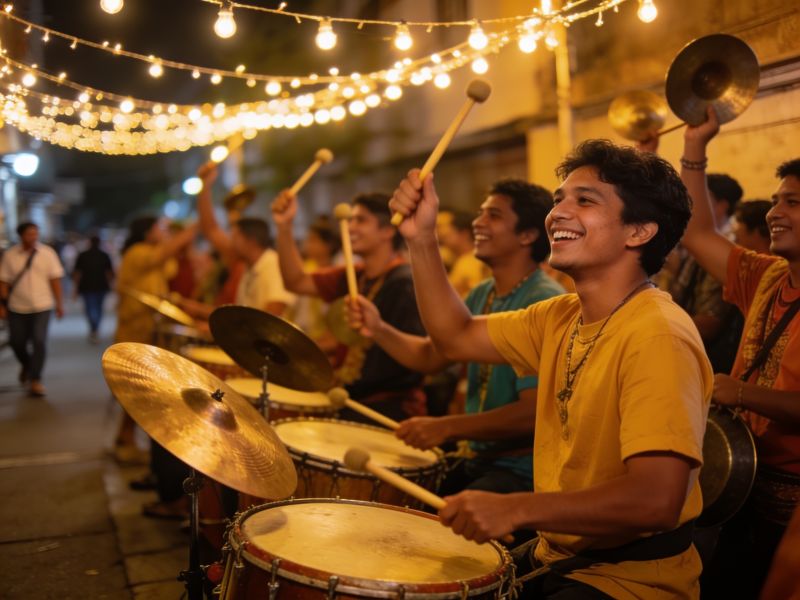
I first heard about Aguero from a flyer taped to a lamppost. "For Aguero—bring your rhythm。" it read, with a hand-drawn image of a bombo legüero and a gong. Aguero had been the neighborhood's unofficial timekeeper, a retired percussionist who repaired instruments in his garage and taught local kids to play rumba patterns on overturned buckets. When he died in April, his family didn't plan a funeral procession. They planned a noise. The drum-and-gong ensemble that gathered that evening wasn't a professional band;it was a rotating cast of students, neighbors, and old bandmates who had each rehearsed in Aguero's garage at some point. They played without a set list, following a call-and-response pattern Aguero had drilled into them: three heavy beats on the gong, then a flurry of drum rolls that felt like rain on a tin roof. That was Aguero celebrated with drums and gongs—messy, loud, and completely unrehearsed.What struck me most was the gong. In most percussion tributes, gongs are background texture. Here, they led. A woman in her sixties—Aguero's sister, I later learned—struck a 24-inch tam-tam with a padded mallet, and the sound hung in the air for a full eight seconds, swallowing the street noise. People stopped talking. A cyclist dismounted. The gong's decay became a moment of silence, but not the kind you'd expect. It was charged。expectant. When the drums re-entered, they did so softly, with brushes on snare, building into a pattern that mirrored a heartbeat. Aguero celebrated with drums and gongs meant letting the metal speak first, then answering with skin and wood. That inversion—gong before drum—was his signature, a quirk he'd picked up playing in a gamelan-influenced ensemble in the 1980s. Few outside his circle knew that. On Thursday, everyone heard it.
By 8:30, the crowd had swelled to include strangers who'd followed the sound from three blocks away. A toddler in a stroller banged a plastic tambourine against the handlebar. An older man in a pressed shirt stood at the edge, mouthing the rhythm counts—"one, two, three, rest"—as if reciting a prayer. I watched a teenager film the gong player on his phone。then look up, startled, when the drummers behind him shifted into a 6/8 pattern. The celebration wasn't polished. The gong player missed a cue. A drum skin loosened and had to be retuned mid-song. Nobody minded. Aguero celebrated with drums and gongs was never about precision;it was about presence. You showed up, you hit something, you listened. That was the whole lesson.When the final gong strike faded—around 9:15, after a sweaty, sprawling version of a rhythm Aguero called "the slow burn"—the crowd didn't applaud. They hummed. A low, collective hum that rose from the back and moved forward。
replacing clapping with something more intimate. I walked home with the gong's overtone still ringing in my left ear, a physical reminder that sound doesn't end when the player stops. Aguero celebrated with drums and gongs, yes—but the instruments kept celebrating him long after the mallets were put down. The city resumed its usual noise: sirens, bus brakes, a dog barking. None of it sounded the same.