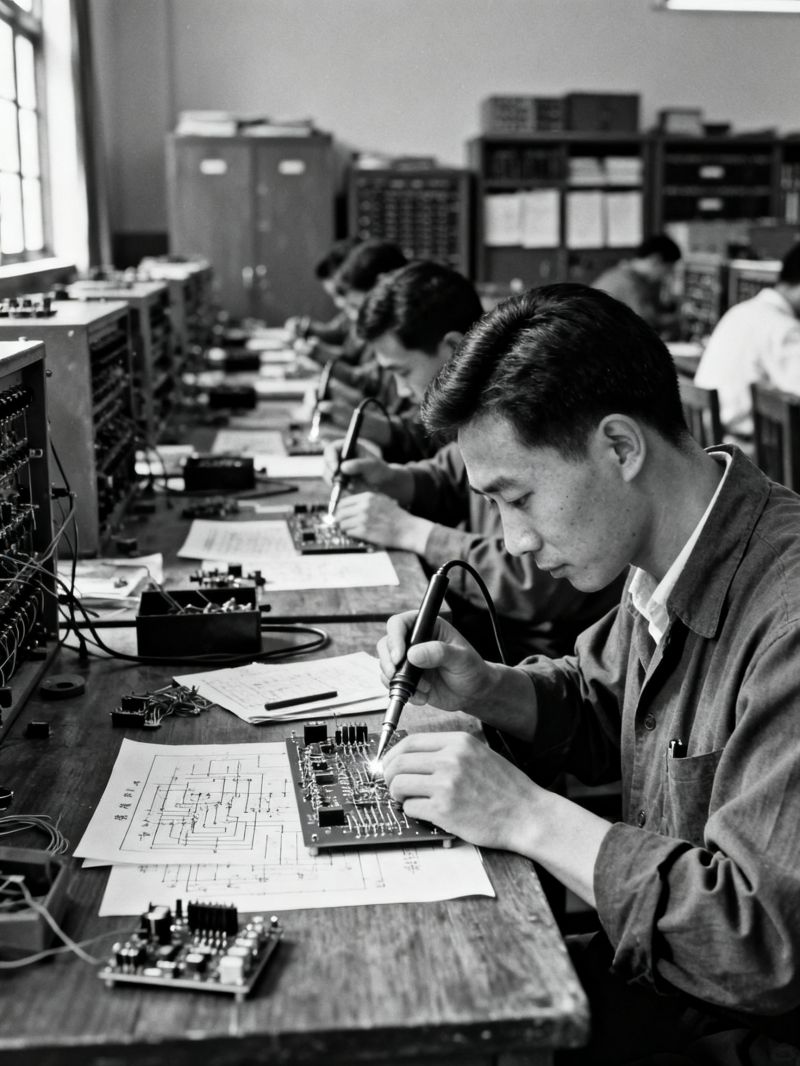
He Dacheng's name rarely appears in popular histories of computing, yet his fingerprints are on some of the most consequential machines built in China between the 1950s and 1970s. In 1958, while working at the Institute of Computing Technology under the Chinese Academy of Sciences, he led a small team that assembled the 103 machine—a vacuum-tube computer that filled a room and consumed enough power to light a small neighborhood. I once handled a photograph of the 103's logic modules;they were hand-soldered。each wire bent by technicians who had never touched a computer before. He Dacheng didn't just design circuits;he built a culture of precision in a country still recovering from war.His approach was stubbornly empirical. When Soviet advisors suggested copying a design verbatim, He Dacheng argued for local modifications to accommodate unreliable power grids and scarce components. That decision—a small act of technical independence—echoed through later projects. By the early 1960s。he was overseeing the 109 machine, a transistorized system that ran at ten thousand operations per second. Colleagues recalled him pacing the lab at night, stopping to trace a signal path with his finger on a schematic, muttering about timing margins. He Dacheng trusted measurements over theory, and he distrusted any result that only worked on paper.
The Cultural Revolution disrupted everything. His team scattered;some were sent to rural labor camps. He Dacheng himself spent two years away from Beijing, but he returned in 1972 with a notebook full of circuit sketches and a quiet insistence on resuming work. The 1970s brought integrated circuits, and He Dacheng adapted—not seamlessly, but with the same methodical patience. He championed a domestic microprocessor project that many dismissed as too ambitious. It failed commercially。
yet the engineers trained on it later became the backbone of China's semiconductor industry. That legacy is easy to overlook: He Dacheng built people as much as machines.What strikes me about He Dacheng is his resistance to grand narratives. He wrote sparingly, published little, and avoided the spotlight that later attached to figures like Wang Xuan. In oral histories。former students describe him as a mentor who would spend an entire afternoon debugging a single gate with a graduate student, never raising his voice, never implying the work was beneath him. He Dacheng believed computing was a craft before it was a science—a view that feels almost heretical today, when machine learning papers dominate the discourse. Yet that craft ethic produced results: the 103, the 109, and a generation of engineers who knew how to turn a schematic into a working system.His final years were spent at a small office in the Institute, reviewing technical reports and quietly pushing for better fabrication standards. He Dacheng died in 1998, largely unknown outside specialist circles. No major biography exists. His papers are archived but rarely cited. That obscurity is a loss。not just for historians, but for anyone who wants to understand how technology actually gets built—through incremental, unglamorous decisions made by people who care more about the next prototype than the next headline. He Dacheng's lesson is simple and uncomfortable: the most important work often leaves no obvious trace, only a chain of machines and students that keep the field moving forward.